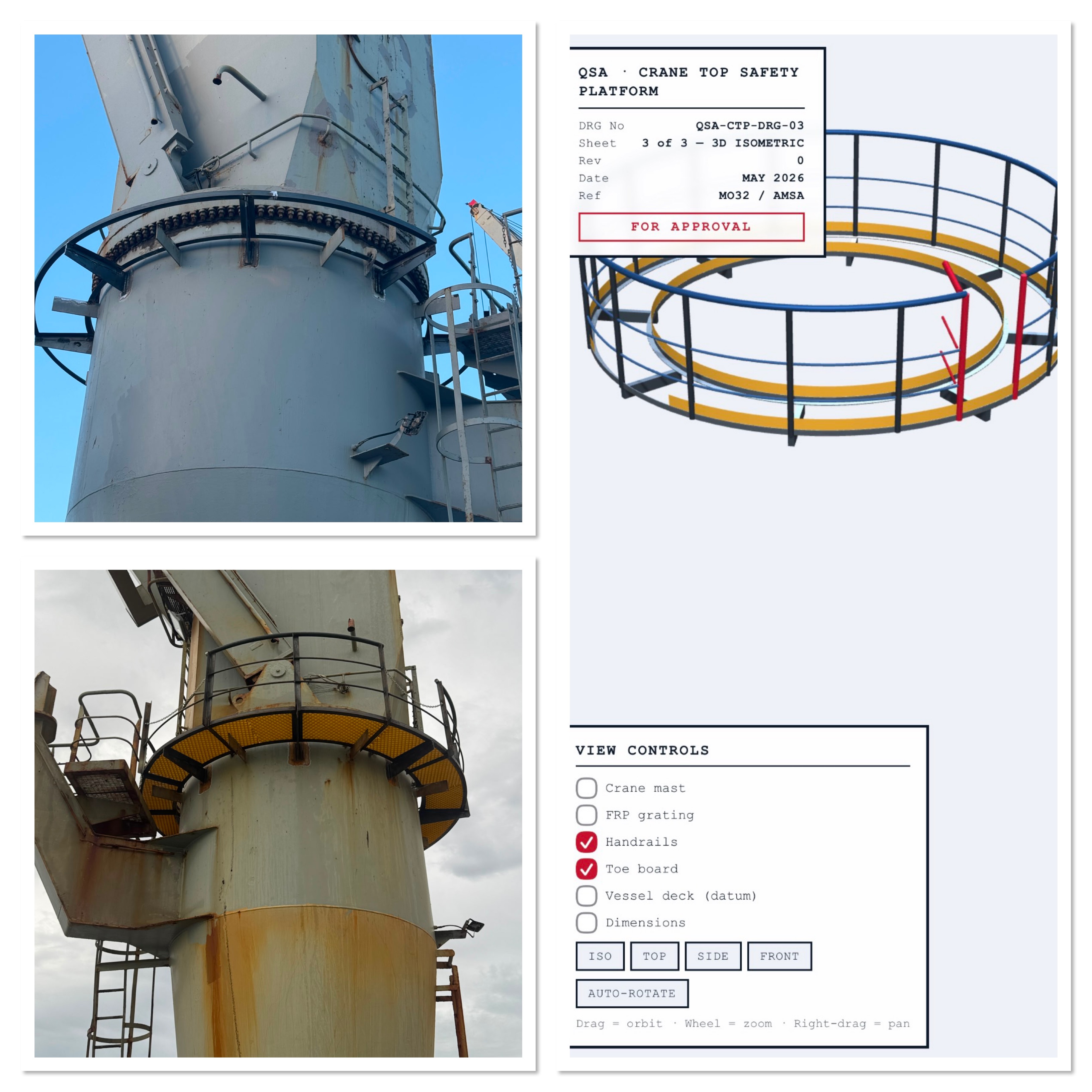
Marine operations demand precision, compliance, and efficiency. When fabricating crane platforms for vessel repairs and modifications, the intersection of accurate structural calculations and strategic prefabrication becomes the difference between project success and costly delays.
Understanding MO32 Compliance in Crane Platform Design
Marine Order 32 (MO32) under the National Law sets strict requirements for vessel structural safety. For crane platform installations, this means:
Why Precision Matters: A single guardrail dimension error can trigger port state control (PSC) deficiencies or delay class society acceptance, extending vessel downtime by weeks
Our fabrication process begins with comprehensive structural analysis:
1. Load Path Definition
For a typical walk-around platform on triple deck cranes:
Platform area: 3 cranes × 2.1m inradius hexagonal sections Total personnel load: 6 workers + 1 supervisor = 900 kg Dynamic load factor: 1.5× (vessel motion compliance) Equipment staging: 500 kg average distributed across platform Design load: (900 + 500) × 1.5 = 2,100 kg working load
2. Beam Sizing & Weld Specification
Each support beam undergoes finite element analysis to ensure:
Stress concentrations at deck attachment points remain < 60% of material yield (SOLAS Q&T steel standards)
Deflection limits ≤ L/300 to prevent guardrail misalignment
Fatigue resistance verified for 20-year vessel service life
3. FRP Grating Panel Confirmation
Fiber-reinforced polymer decking selections are validated for:
Slip resistance (DIN 51130 R11 minimum)
Chemical compatibility (fuel, crude, seawater environments)
Weight reduction (vs. steel) for vessel stability impact
Calculation Transparency: All structural computations reference DNV, ABS, or LR standards and are submitted to vessel class society for formal review before fabrication begins.
Strategic Prefabrication: Time & Cost Efficiency
Prefabrication in controlled workshop environments delivers measurable advantages over onsite assembly:
Quality Control Benefits
Dimensional accuracy: CNC-cut components within ±1mm tolerances—eliminating field rework
Weld consistency: Full traceability of welder qualifications and NDT (non-destructive testing) records
Surface preparation: Blast and paint in climate-controlled shop vs. variable vessel weather
Schedule Optimization
Comparison of typical project timelines:
Every prefabricated platform includes:
Structural calculations package: FEA reports, load verification, material certs (MTC/3.1)
Fabrication records: Welder IDs, WPS (Welding Procedure Specification) compliance logs, NDT reports
Assembly drawings: Site-specific installation sequences with torque specs for bolted connections
MO32 certification: Platform technical file confirming guardrail heights, deck slope limits, attachment loads
This complete package arrives at the vessel with full surveyor confidence—reducing approval cycles from weeks to hours.
Case Study: Triple Deck Crane Platforms (Brisbane Port)
Three identical 2.1m-diameter hexagonal platforms required walk-around access and cargo staging for container vessel modifications. Using prefabrication:
Authority approval: 4 hours—no deficiencies or rework required
Qualships-Why Partnering with Specialists in Precision Fabrication matters
Crane platform fabrication isn't simply steel bending. It's a technical discipline demanding:
Regulatory expertise: Deep MO32, SOLAS, and class society navigation
Structural engineering: Validated analysis methodologies and material specifications
Fabrication discipline: Certified welders, documented procedures, and 100% traceability
Logistics integration: Scheduling coordination to minimize vessel availability impact
Your vessel's safety framework and your operational schedule depend on getting it right the first time.