Advanced Vibration Analysis: Solving Recurring Equipment Failures in Maritime Operations
When Standard Maintenance Isn’t Enough
Recurring equipment failures are a maritime operator’s nightmare. When critical systems repeatedly malfunction despite routine maintenance, it’s a sign that a deeper diagnostic approach is needed. At Qualships, we encountered a complex situation where essential propulsion equipment was experiencing recurring failures that threatened operational reliability. Rather than applying band-aid solutions, we recommended a comprehensive vibration analysis program—a proactive engineering approach that delivered actionable insights and lasting results.
The Challenge: Diagnosing Hidden Faults
Critical maritime equipment operates under demanding conditions. Gearboxes, motors, and propulsion systems are subject to extreme loads, vibration, and dynamic stresses. When equipment fails repeatedly, the root cause often isn’t obvious. Standard inspections, component replacements, and routine overhauls may temporarily resolve issues, but without understanding the underlying mechanics, failures recur.
This is where vibration analysis transforms the maintenance equation.
What is Vibration Analysis?
Vibration analysis is a predictive maintenance technique that measures and evaluates mechanical vibrations across equipment during operation. By capturing detailed data from multiple sensor locations, engineers can identify:
• Gear mesh abnormalities and wear patterns
• Motor bearing degradation
• Cavitation and fluid interaction issues
• Structural resonances and misalignment
• Early-stage fault development
Unlike visual inspection or basic testing, vibration analysis provides quantitative, frequency-domain data that reveals exactly where and why problems are occurring.
Our Approach: Baseline Assessment and Commissioning Trials
When we undertook the vibration analysis project for critical equipment that had experienced repeated failures, we implemented a structured methodology:
1. Comprehensive Sensor Installation
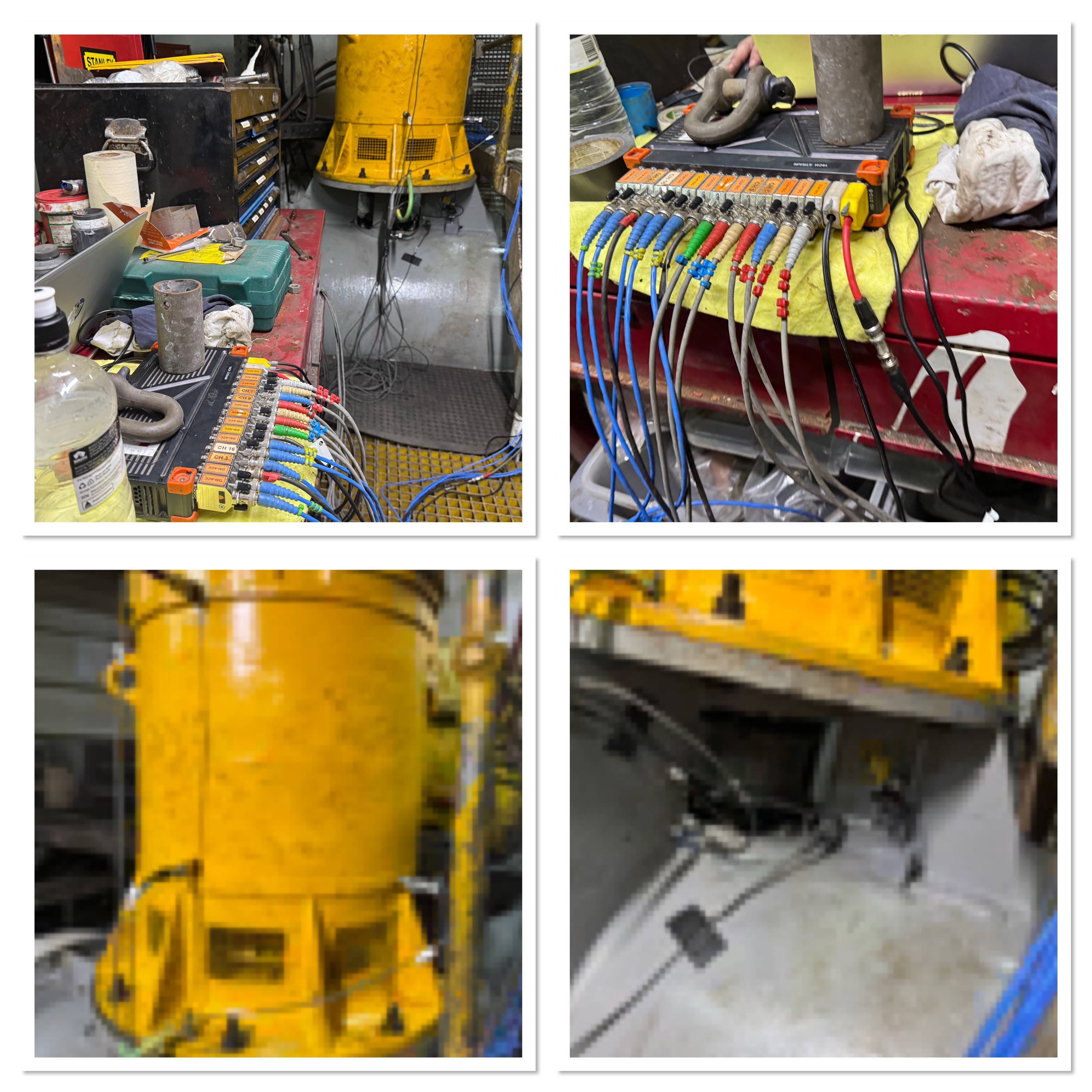
We deployed accelerometers at strategic locations across the equipment system—at motor bearings, gearbox input/output points, and thruster housing locations. This multi-point approach captures the full vibration signature and enables comparative analysis between components.
2. Baseline Measurements During Operation
Measurements were conducted across all operational ranges and thrust configurations, from idle speeds through maximum operating conditions. This allowed us to establish a comprehensive baseline and identify conditions where vibration levels spiked.
3. Frequency Domain Analysis
Raw vibration data was processed using advanced signal processing to isolate specific frequency components. By examining shaft orders, gear mesh frequencies, and propeller blade pass frequencies, we could pinpoint exactly which mechanical elements were generating problematic vibrations.
4. Comparative Assessment
Equipment was evaluated against international standards (ISO 20816, ISO 20283-4) to determine operational zones and acceptability criteria. High readings were analyzed to determine whether they indicated mechanical faults or were inherent to normal operation under certain conditions.
5. Root Cause Identification
Detailed frequency analysis revealed that high vibration levels during certain operating modes were dominated by fluid dynamics effects rather than mechanical gear degradation. This finding was critical—it meant that the recurring failures had a specific operational trigger rather than indicating widespread component deterioration.
Key Findings
The vibration analysis revealed several important insights:
Equipment Status: Detailed assessment showed that critical gearbox components were operating within acceptable parameters, with acceleration levels at gear mesh frequencies remaining below concerning thresholds. This indicated the equipment was mechanically sound.
Operational Thresholds: Specific operating configurations generated higher vibration levels due to fluid interactions. Understanding these conditions allowed us to recommend operational protocols to manage risk.
Condition Baseline: The comprehensive baseline established a benchmark for future monitoring. Any deviation from these baseline patterns would indicate developing faults, enabling genuinely predictive maintenance.
Comparison Analysis: New equipment showed cleaner vibration signatures compared to longer-service components, allowing us to establish realistic aging patterns and plan component replacement strategically.
Why This Matters for Maritime Operations
For vessel operators and marine technical teams, vibration analysis delivers several advantages:
Prevent Catastrophic Failures
By identifying developing faults before they become critical, vibration analysis prevents unplanned downtime and emergency repairs at sea.
Optimize Maintenance Planning
Instead of replacing components on a fixed schedule, maintenance is scheduled when data indicates actual degradation—reducing unnecessary expenses while ensuring reliability.
Informed Operational Decision-Making
Understanding which conditions generate elevated vibration allows crews to operate equipment more intelligently, avoiding high-stress scenarios when possible.
Extended Equipment Life
By addressing root causes rather than symptoms, components can be kept in service longer and replaced strategically rather than reactively.
Documentation and Compliance
Comprehensive vibration reports provide documented evidence of equipment condition, supporting regulatory compliance and insurance requirements.
The Technical Advantage
Modern vibration analysis isn’t guesswork. Our approach employed:
• High-precision accelerometers calibrated to capture sub-micron vibration amplitudes
• Multi-channel synchronized data acquisition across the entire system
• Advanced signal processing software for frequency domain transformation
• ISO-standard assessment criteria and zone classification
• Shaft-order analysis to isolate components operating at different speeds
• Acceleration spectrum analysis to detect high-frequency bearing wear signatures
This level of detail transformed our understanding of the equipment’s actual condition and the specific mechanisms driving the observed failures.
From Analysis to Action
The vibration analysis provided clear recommendations:
1. Current Operation: Equipment was acceptable for continued operation under standard protocols
2. Operational Limits: Certain operating modes should be used judiciously to manage vibration-related wear
3. Future Monitoring: Repeated vibration measurements at regular intervals would track condition changes over time
4. Maintenance Strategy: Condition-based maintenance replaced calendar-based maintenance for specific components
Conclusion: Data-Driven Solutions to Recurring Problems
When standard maintenance stops working, it’s time for advanced diagnostics. Vibration analysis transformed a recurring equipment failure issue into a managed, understood, and predictable condition. Rather than repeatedly replacing components or worrying about the next failure, the operation now has quantitative data, clear operational guidelines, and a path forward.
For any critical maritime equipment experiencing mysterious or recurring failures, vibration analysis should be your first call. It’s not just maintenance—it’s engineering-based risk management.
About Qualships: We provide comprehensive technical services in Australia for marine operations, including advanced diagnostics, equipment commissioning, and condition monitoring solutions. When standard approaches fall short, we bring engineering expertise and specialized equipment to solve complex maritime challenges.